
Don't let FOIL waste staff time.
FOIL rarely breaks inside a tool. It breaks at the handoffs between people. This is how we fix it from the process up, and a field guide you can use to map your own.
People and process first. Then technology.
Most FOIL trouble looks like a software problem and isn't. A request lands at the wrong department. The five-day clock starts and nobody notices. Records sit in three systems and a file cabinet. The county attorney sees the request last instead of in parallel.
So we settle ownership, deadlines, and handoffs across all five steps first, then put technology where it earns its place. A northern New York county runs its FOIL requests through a FOIL manager we built this way.
The Five Rs
-
R1
Receive Intake
- The job
- Log every request the day it lands. The clock starts at receipt.
- Fix the process
- One front door and one owner, even when a request lands at a department.
- Then apply tech
- A single intake form and log that sets every deadline automatically.
-
R2
Route Handoff
- The job
- Get the request to every office holding records, with a due date attached.
- Fix the process
- Named contacts per department, a sensitivity screen, and an agreed escalation path.
- Then apply tech
- Automatic routing rules, reminders, and a shared status board anyone can read.
-
R3
Retrieve Search
- The job
- Find responsive records in every system, legacy files and paper included.
- Fix the process
- Departments own the search. Agree on how records are named and filed.
- Then apply tech
- Rich search across every field, record type and date range, from one place.
-
R4
Review Redact, sign off
- The job
- Apply §87(2) exemptions, redact, and document every withholding.
- Fix the process
- A denial library tied to statutory citations. Counsel works in parallel, not last.
- Then apply tech
- AI-suggested redaction, with a person approving every mark.
-
R5
Release Deliver, close
- The job
- Deliver by the committed date, state the appeal route, close the file.
- Fix the process
- Standard response templates and a closed record for every request.
- Then apply tech
- Turnaround reporting, and a public portal for frequently requested records.
Every clock needs one owner.
One owner and one record per request keeps every deadline visible and on time.
Measure before you buy.
A few months of clean request data turns a platform decision into arithmetic instead of a guess.
Make self-service the default.
Publish frequently requested records so residents can find them on their own, no request required.
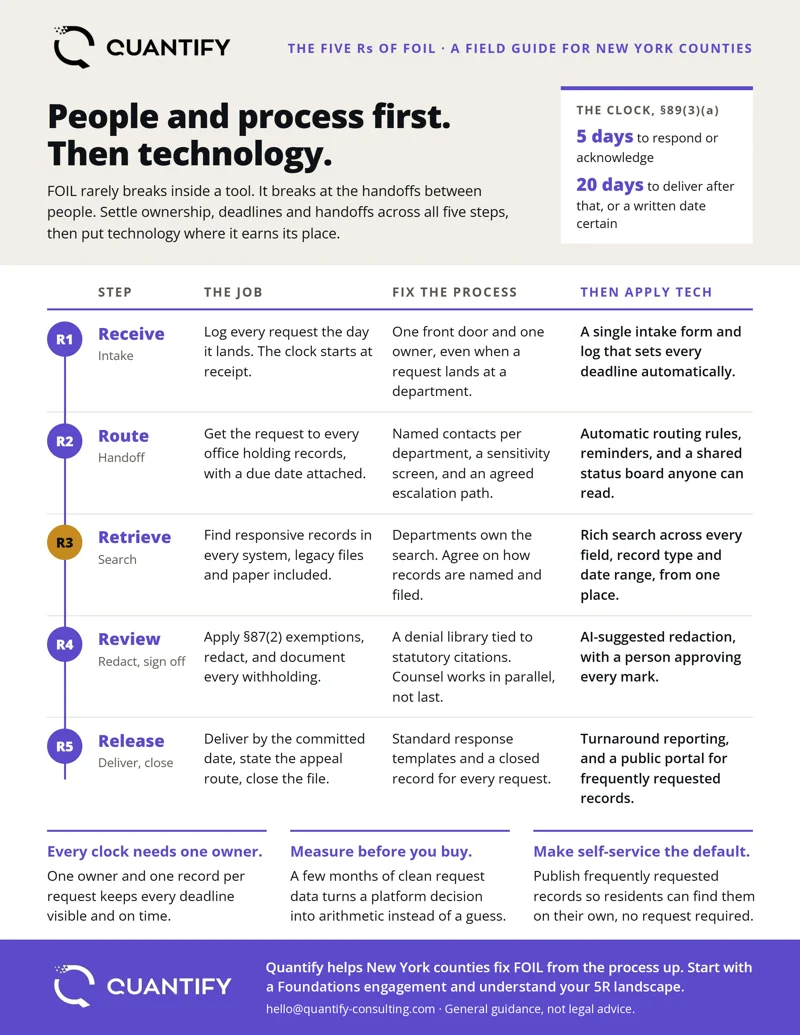
Get the field guide
One page, printable, built to map your own FOIL process step by step. Bring it to your next department heads meeting.
Thanks. It's yours.
Download the field guide (PDF)General guidance, not legal advice.